

Cardiology billing
Every test split, sequenced and checked against NCCI before the claim goes out.
We bill cardiology the way Medicare pays it: professional and technical parts claimed by the right party for the setting, monitors and device checks inside their billing periods, and cath and PCI coded to the 2026 NCCI edits.
- Full-service rate
- 3% to 6% of collections
- Same-day test TCs
- 2nd and later paid at 75%
- Remote ICD checks
- Billed once per 90 days
- New & smaller practices
- Flexible monthly minimum
What makes cardiology billing different
Most cardiology revenue comes from tests, and almost every test has two parts: the equipment and staff (the technical component) and the cardiologist’s reading (the professional component). Who bills each part depends on where the test was done, a second test for the same patient on the same day is paid less, and stress tests, monitors and device checks each have their own code sets.
For 2026, the physician fee schedule final rule took 2.5 percent off the work value of non-time-based services, which takes in most tests and procedures. We bill all of it inside our full revenue cycle service, at 3% to 6% of collections.
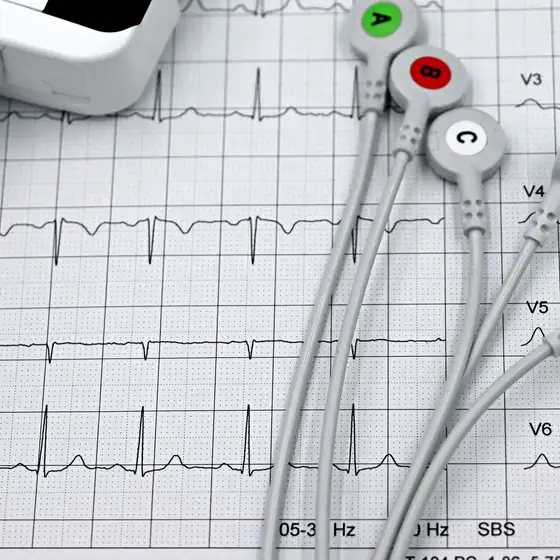
Professional, technical or global: who bills what
Medicare rules, from the 2026 fee schedule files and CMS manuals. Commercial plans set their own, so we check each contract.
- Global, no modifierThe practice owns the equipment and its cardiologist reads the test, so one line covers both parts.
- Modifier 26The reading and written report only, for a test run on a hospital’s or another owner’s equipment.
- Modifier TCEquipment, staff and supplies only, billed by the owner when someone outside the practice reads the study.
- Split codesSome tests split by code instead: ECG 93000 (global), 93005 (tracing) and 93010 (interpretation). 26 and TC never go on these.
- Hospital outpatientsThe hospital is paid the technical part under OPPS, so the cardiologist bills only the reading, with 26.
- Emergency ECGsMedicare pays one interpretation and report per ECG. A note such as "EKG normal" is a review, already paid in the E/M.
Stress tests, echo and ambulatory monitors
Stress tests are billed by component: 93015 global, 93016 supervision, 93017 tracing, 93018 interpretation and report. Medicare’s 2026 relative value file lists 93015 to 93017 as needing direct supervision. The 2026 NCCI policy manual folds the IV line, any pharmacologic infusion and the ECG strips into the test, and a same-day E/M needs its own significant reason and modifier 25.
Echocardiograms take 26 and TC. Contrast given during an echo is not billed as a separate injection, add-on 93352 covers contrast during a stress echo (93350 or 93351), and hospitals bill echo with contrast on C8921 to C8930 instead of the CPT code.
Ambulatory monitors come in sets: Holter up to 48 hours (93224 to 93227), extended monitoring over 48 hours to 7 days (93241 to 93244) and over 7 to 15 days (93245 to 93248), event monitors (93268 to 93272) and mobile telemetry (93228 and 93229). Noridian, a Medicare contractor, says overlapping monitoring denials are among its top provider calls. Medicare checks claims nationwide for overlaps, and those denials carry no appeal rights.
Device checks, in person and remote
In-person programming and interrogation of pacemakers, defibrillators and loop recorders (93279 to 93292) take 26 and TC. For defibrillators, a Medicare contractor’s billing article lets in-person checks be billed each time they are medically necessary and treats remote interrogation (93295, with the technical 93296) as a 90-day service, billed once per period however many transmissions arrive. An in-person check in the same 90 days is included, and a remote and an in-person service are not billed on the same day.
93294 and 93295 are the physician’s review and 93296 the technical part, billed as separate lines. Defibrillator interrogation is never billed with a cardioversion, which includes it.
Cardiac cath, PCI and the NCCI edits
Diagnostic catheterization codes are built as combinations: right heart (93451), left heart with ventriculography (93452), both (93453), and coronary angiography alone or with heart catheterization and graft studies (93454 to 93461). The NCCI manual includes catheter placement, fluoroscopy, injections, ECG strips, ultrasound guidance and cardiac output measurement (93598) in them. In a hospital lab, the cath codes are billed with modifier 26.
A PCI includes the coronary catheterization, dye injections and fluoroscopy. A diagnostic angiogram before it is billed only when it is medically necessary, and one PCI code is reported per major coronary artery (left main, left anterior descending, circumflex, right and ramus intermedius), plus one for each of up to two branches of the arteries that have them.
Prior authorization for cardiac imaging and tests
Each plan sets its own approval list, and the lists change. For plans that require precertification, Cigna has eviCore review nuclear cardiology, stress echocardiograms and diagnostic heart catheterization, along with CT, MRI and PET, but not inpatient, emergency room or 23-hour observation services. UnitedHealthcare took resting echoes (93306 to 93308) off its commercial and Exchange list on January 1, 2026. Our prior authorization team checks each order against the patient’s plan and matches the approved code to the test performed.
Why cardiology claims deny
Common cardiology denials, with the reason codes that often carry them (codes vary by payer):
- 26 or TC on a code that cannot take them, such as 93010 or 93015 (CO-4)
- Global billed for a hospital test, or the wrong place of service (CO-5)
- Technical part already paid to the hospital or another group (CO-B20)
- A diagnosis that does not support the test (CO-11 or CO-50)
- A component billed with the test it belongs to, such as ECG strips with a stress test (CO-97 or CO-236)
- No approval on file where the plan requires one (CO-197)
- A second same-day test paid at the reduced rate (CO-59): a reduction to check, not a denial
Each goes through our denial management process, corrected and resubmitted or appealed with the order and report. Our denial code guides explain what each code means and how it is fixed.
How we run cardiology billing
Map each test and site
Every test is set up as global, 26 or TC for each location, with each payer’s approval list.
Confirm before the test
Coverage, the approval and the ordering provider are checked before nuclear studies, stress echoes and caths.
Code from the report
Components, monitor sets, device periods and NCCI edits are checked before claims go out.
Work what comes back
Denials are worked by payer and reason code, and same-day reductions are checked against the fee schedule.
Report monthly
Collections, days in A/R, denials by reason and approvals close to expiring, by payer, site and cardiologist.
Credentialing for cardiologists
Every cardiologist who treats or reads needs to be enrolled with each payer under the group that bills for them, and a claim for a date before the effective date can come back with reason code B7: the provider "was not certified/eligible to be paid for this procedure/service on this date of service." Our provider credentialing service tracks every effective date in writing at $189 per payer application, less in bulk.
Not sure your components and modifiers are right? Send us a month of cardiology claims with the reports and we’ll check them, free.
When the cardiologist reads a test that ran on someone else’s equipment, usually a hospital’s. Modifier 26 bills the interpretation and report, and the hospital is paid the technical part. Codes that are already split, such as 93010 for an ECG reading or 93016 and 93018 for a stress test, never take 26 or TC.
The cardiologist bills 93016 for supervising the test and 93018 for the interpretation and report. The hospital bills the tracing, 93017, as the technical part. 93015, the global code, is for a practice that does all three in its own office. The IV line, any pharmacologic infusion and the ECG strips are included.
A Medicare contractor’s billing article treats remote interrogation of a defibrillator, 93295 for the physician and 93296 for the technical part, as a 90-day service billed once per period, however many transmissions arrive. An in-person check in the same period is included, and a period with no interrogation is not billed.
Since 2013, Medicare has reduced the technical part of the second and later diagnostic cardiovascular tests for the same patient on the same day, by the same physician or group NPI. The highest-paid test is paid in full and the others at 75 percent, and the professional part is not reduced. The remittance usually shows reason code 59.
Our full-service rate is 3% to 6% of monthly collections, set by your volume, with no setup or onboarding fees and flexible monthly-minimum plans for new and smaller practices. It covers eligibility checks, prior authorizations, coding, claims, payment posting, denials and A/R follow-up, plus component, monitor and device-period checks. Your exact rate comes after a free A/R review. Our guide to medical billing costs shows how to compare quotes.
Yes. We don’t list our clients on this site, but ask us and we’ll arrange it: with a current client’s permission, we share their contact details so you can hear how we work from them directly.
From our guides

How to calculate days in A/R
The formula with a worked example and a calculator, the benchmarks, why a good average can hide old claims, and the fixes that bring days in A/R down.
How much do medical billing services cost?
The four ways billing companies price their work, the fees that sit outside the rate, and in-house arithmetic built from BLS data, so you can compare quotes on your own numbers.

Send us your last 90 days of cardiology claims.
We’ll review them free and show you where components, same-day reductions or device periods are costing you money.