
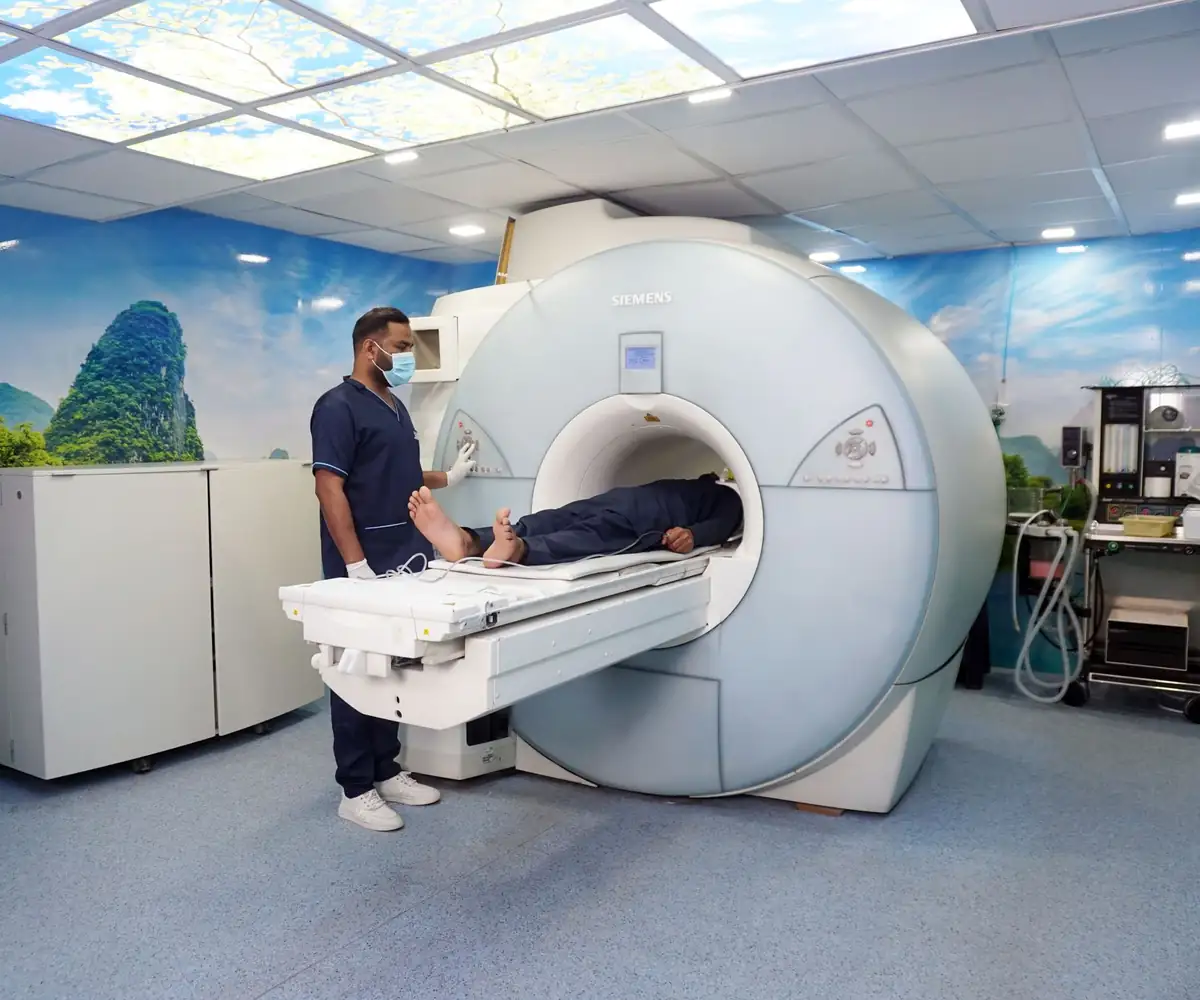
Radiology billing
Every study split, reduced and authorized the way the payer will read it.
We bill imaging the way Medicare pays it: professional and technical parts to the right party, same-session reductions expected and checked, contrast and supervision matched to each study, and authorizations confirmed before the scan.
- Full-service rate
- 3% to 6% of collections
- Same-session imaging
- TC 50% and PC 5% off extras
- Medicare AUC program
- Paused, rules rescinded
- New & smaller practices
- Flexible monthly minimum
What makes radiology billing different
Imaging pays per study, and almost every study is split between whoever owns the scanner and whoever reads the images. Medicare cuts payment for several studies in one session and for older equipment, and a study done without the supervision it requires is not payable.
For 2026, the physician fee schedule final rule took 2.5 percent off the work value of non-time-based services, which takes in imaging interpretation. We bill radiology inside our full revenue cycle service, at 3% to 6% of collections.
Professional, technical or global: who bills what
Medicare rules. Commercial plans set their own, so we check each contract.
- Global, no modifierThe practice or imaging center owns the equipment and reads the study: one line covers both parts.
- Modifier 26The radiologist’s interpretation and written report, for a study done on a hospital’s or another owner’s equipment.
- Modifier TCEquipment, technologist and supplies, billed by the owner when an outside radiologist reads.
- Hospital patientsThe hospital is paid the technical part, under OPPS or in its inpatient payment. A TC billed during an inpatient stay is recouped.
- Repeat and added viewsImages retaken for quality, or added after the radiologist reviews the first set, are one unit of the code for the whole study.
- Post-procedure imagesA study to check a procedure’s result, such as after a fracture reduction: the TC may be billed, the PC may not.
- Emergency readsMedicare pays one interpretation of an ED study, generally the first claim received, and a second (modifier 77) only in unusual cases.
Same-session reductions and equipment cuts
In Medicare’s 2026 relative value file, CT, CTA, MRI, MRA and most ultrasound codes form one imaging family. When two or more are done in the same session on the same day, the technical part of the highest-priced study is paid in full and each other one at 50 percent, and the professional part of each additional study is cut 5 percent. Plain x-rays and mammograms are not in the family. The remittance shows reason code 59, "Processed based on multiple or concurrent procedure rules."
Equipment cuts follow chapter 13 of the Medicare Claims Processing Manual. CT on a scanner that misses the NEMA XR-29 dose standard carries modifier CT and loses 15 percent of the technical payment, film x-rays carry FX and lose 20 percent, and computed radiography carries FY and loses 10 percent.
Contrast and supervision
A with-contrast code covers the whole study, and under the 2026 NCCI radiology chapter the IV start and the contrast injection are part of the procedure, not separate lines. Outside the hospital, the agent is billed: low-osmolar iodinated contrast per milliliter (Q9965 to Q9967), paid like a drug at average sales price plus 6 percent, and gadolinium agents by their own codes, some per 0.1 mL, such as A9575.
Supervision is set per code: the 2026 file lists general supervision for a non-contrast MRI or CT (70551, 74176) and direct supervision for the same studies with contrast (70553, 74177). Under 42 CFR 410.32, a test done without its required supervision is not reasonable and necessary, and direct supervision can now be given by real-time audio and video (not audio only) for services without a 10- or 90-day global period.
Prior authorization, and where Medicare’s AUC program stands
Some commercial plans hand imaging authorization to a radiology benefit manager. For plans that require precertification, Cigna uses eviCore for outpatient CT, MRI, PET and nuclear cardiology, may add a site-of-care review when a hospital outpatient MRI or CT is requested, and makes the performing facility responsible for confirming the referring physician got the approval. Inpatient, ER and observation studies are exempt.
Medicare’s Appropriate Use Criteria program for advanced imaging is not in force. CMS paused it and rescinded its regulations effective January 1, 2024, and claims no longer carry AUC information; its program page, updated March 2026, still shows it paused. Our prior authorization team confirms each order’s approval before the patient is scanned.
Mammography and screening rules
Medicare pays only facilities holding an FDA certificate under the Mammography Quality Standards Act. Under chapter 18 of the Claims Processing Manual, a screening mammogram (77067) is covered for women over 39 once 11 full months have passed since the month of the last one, once between 35 and 39 as a baseline, and not under 35, with the Part B deductible waived. Screening claims need diagnosis Z12.31.
Tomosynthesis is an add-on: 77063 with a screening mammogram, G0279 with a diagnostic one. When a screening turns diagnostic on the same day, the NCCI manual puts modifier GG on the diagnostic code and 59 or XU on the screening code.
Why radiology claims deny
Common imaging denials, with the reason codes that often carry them (codes vary by payer):
- No approval on file, or a study different from the one approved (CO-197 or CO-198)
- A diagnosis that does not support the study (CO-11 or CO-50)
- 26 or TC missing, or on the wrong line (CO-4)
- The component already paid to the hospital or another group (CO-B20)
- CT and CTA, or MRI and MRA, billed from one acquisition (CO-97 or CO-236)
- A mammogram from a facility not on the FDA list (CO-B7), or a screening too soon (CO-119)
Each goes through our denial management process, corrected and resubmitted or appealed with the order, the report and the approval. Our denial code guides explain what each code means and how it is fixed.
How we run radiology billing
Set up each site and reader
Each location is mapped to global, 26 or TC billing, with its equipment modifiers and each payer’s approval rules.
Confirm before the scan
The approval is checked against the exact study ordered, with or without contrast, before the patient arrives.
Code from the signed report
Contrast, components, NCCI pairs and screening rules are checked before the claim goes out.
Check every payment
Same-session reductions, equipment cuts and component payments are checked against the fee schedule.
Report monthly
Collections, days in A/R, denials by reason and studies waiting on approval, by payer, site and radiologist.
Credentialing for radiologists and imaging centers
A radiology group enrolls each radiologist with every payer, and a freestanding imaging center outside a physician practice or hospital enrolls as an independent diagnostic testing facility (IDTF). Under 42 CFR 410.33, an IDTF needs a qualified supervising physician who covers no more than three sites, $300,000 of liability insurance per location if it sees patients, and must report changes of ownership, location or supervision within 30 days. A fixed-site IDTF cannot share space or testing equipment with another Medicare-enrolled supplier. Our provider credentialing service handles group, radiologist and IDTF enrollment at $189 per payer application, less in bulk.
Not sure your components and reductions are right? Send us a month of imaging claims with the reports and we’ll check them, free.
The radiologist who reads the study bills the professional component with modifier 26, and the equipment owner bills the technical component with TC. When one practice or imaging center does both, it bills the global code with no modifier. For hospital patients, Medicare pays the technical part to the hospital, so the radiologist bills only the 26.
No. CMS paused the program and rescinded its regulations effective January 1, 2024, so Medicare claims no longer carry AUC information, and CMS’s program page, updated in March 2026, still shows it paused. Commercial plans run their own authorization programs, some through a radiology benefit manager, so we still check every advanced imaging order against the patient’s plan.
Outside the hospital, the contrast agent can be; the injection cannot. Low-osmolar iodinated contrast is billed per milliliter with Q9965 to Q9967, and gadolinium agents with their own codes, in units set by each code’s dose. The IV start and the injection are part of the with-contrast study. For hospital outpatients, the hospital bills the contrast.
For women over 39, once 11 full months have passed since the month of the last screening, so a January screening can be repeated the next January. Women 35 to 39 get one baseline screening, and none is paid under 35. The Part B deductible is waived, and the facility must hold an FDA mammography certificate.
Our full-service rate is 3% to 6% of monthly collections, set by your volume, with no setup or onboarding fees and flexible monthly-minimum plans for new and smaller practices. It covers eligibility checks, prior authorizations, coding, claims, payment posting, denials and A/R follow-up, plus component, reduction and contrast checks. Your exact rate comes after a free A/R review. Our guide to medical billing costs shows how to compare quotes.
Yes. We don’t list our clients on this site, but ask us and we’ll arrange it: with a current client’s permission, we share their contact details so you can hear how we work from them directly.
From our guides

How to calculate days in A/R
The formula with a worked example and a calculator, the benchmarks, why a good average can hide old claims, and the fixes that bring days in A/R down.
How much do medical billing services cost?
The four ways billing companies price their work, the fees that sit outside the rate, and in-house arithmetic built from BLS data, so you can compare quotes on your own numbers.
Send us your last 90 days of imaging claims.
We’ll review them free and show you where components, reductions or authorizations are costing you money.